
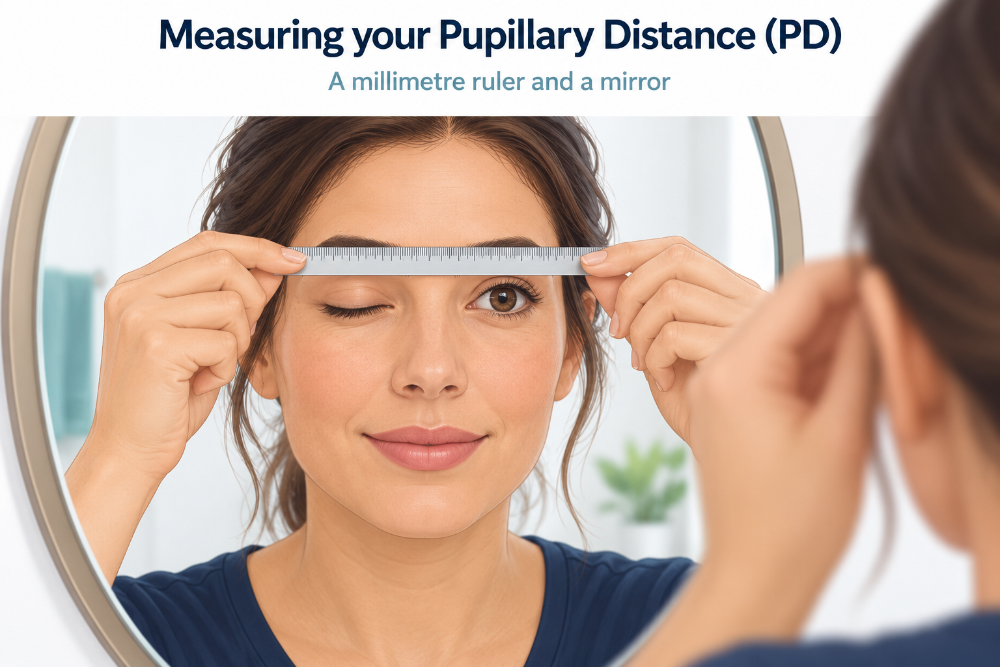
How to find your Pupillary Distance (PD)
Your Pupillary Distance (PD) is the distance between the centres of your pupils, measured in millimetres. It helps us position your prescription lenses correctly.
Not on your prescription?
Ask the optician who supplied your current glasses whether they have your distance PD on record. If they cannot provide it, another optician may offer a measurement service—ask whether there is a charge.
Alternatively, adults can measure their PD at home using a millimetre ruler and a mirror.
Measuring your PD at home
Stand or sit approximately 30 cm from a mirror in good light.
Hold a millimetre ruler horizontally against your eyebrows.
Close your right eye and align the ruler’s 0 mm mark with the centre of your left pupil.
Keep your head and the ruler still. Open your right eye and close your left eye.
Read the number directly above the centre of your right pupil. This is your PD in millimetres.
Repeat several times to check that you get the same result.
For rugby goggles, use your distance PD, rather than your reading or near PD.
Before submitting your measurement
PD may be written as one number, such as 63 mm, or two numbers, such as 31 mm / 32 mm. If you have two measurements, provide both and keep the right and left labels.
Do not use the numbers printed on your glasses frame—these describe the frame size.
If your readings vary or you are unsure, have your PD checked by an optician.
For children, we recommend having PD measured by an optician. A professional measurement is also recommended for strong prescriptions or prescriptions containing prism.